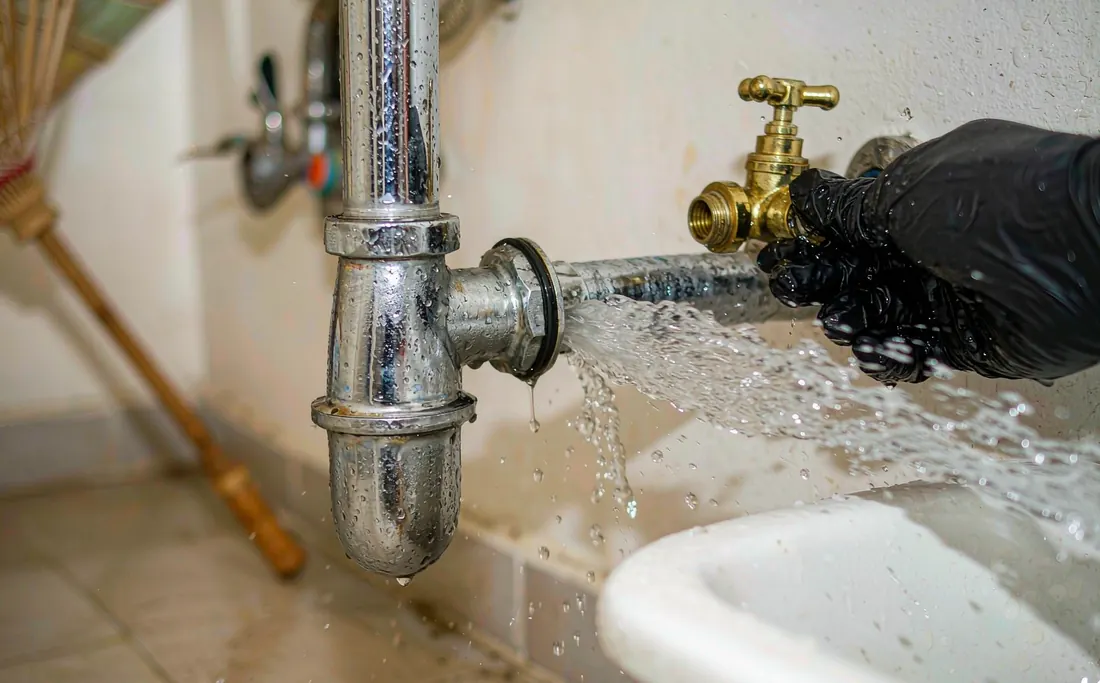
A pipe bursts at 1 AM. Water is spreading across the bathroom floor, your neighbour is knocking, and you are trying to find a phone number in a language you do not read fluently. This is the situation that most often turns a manageable repair into a very expensive one — not because the pipe is hard to fix, but because the first ten minutes were spent in the wrong order.
Here is what to do, in the order that limits damage.
Water near electrics? Deal with that first.
If water is anywhere near sockets, a light fitting, a water heater or the distribution board, switch off the relevant circuit breaker — or the main breaker — before you touch anything else. Electricity and standing water is the only risk in this article that can kill you. Everything below can wait thirty seconds.
Step 1: Stop the water
Finding the shut-off valve while water is spraying is a bad time to learn where it is, so if you only do one thing after reading this, do it now while the apartment is dry.
In Guangzhou, the main shut-off for a flat is usually in one of these places:
- Beside the water meter — often in a small service box at the entrance, in the corridor, or inside the bathroom near the door.
- In the bathroom service shaft — a panel or box on the wall behind or beside the toilet, sometimes with a small round handle.
- Under the kitchen sink — more common in newer fit-outs, and usually the valve for the kitchen line only rather than the whole flat.
- In the corridor riser cupboard — shared between flats. Occasionally locked, which is why the management office number matters.
- Outside, at the building's main valve. If you cannot find anything inside and water is pouring, this is the one to ask the security desk or management office for.
Turn the handle clockwise until it stops. If it will not budge, do not force it hard enough to snap the handle — some older valves in Yuexiu and Liwan blocks are seized solid. Go to the next one upstream instead.
If a valve is stuck, call the management office (物业)
They can close the building valve, and they will need to know anyway if water is reaching other apartments. Do not wait until morning to tell them — a leak that crosses into a corridor or a neighbour's ceiling becomes a conversation about who pays.
Step 2: Contain what has already escaped
Every extra square metre of wet floor is another square metre of drying, warping and possible ceiling damage below you. In Guangzhou's humidity, wet gypsum board and wood floor underlay do not dry by themselves.
- Towels along the doorway to stop water running into other rooms or the corridor.
- Buckets or basins under any active drip, and empty them regularly rather than letting them overflow.
- Lift rugs, cardboard boxes, and anything fabric off the floor. Shoes, bags and luggage first — they are the things you will actually miss.
- If water is coming through a ceiling, put a container under it and — where it is safe to reach — start a small hole with a screwdriver at the lowest point of the bulge. It sounds destructive, but a controlled drip is far better than an entire section of ceiling coming down at once.
Step 3: Photograph everything, before you clean up
Before the towels go down in a different pattern and before anything is moved:
- Photograph the source with the leak visible.
- Photograph the floor and any damaged property with something for scale.
- Take a short video that pans across the whole room — it is much harder to dispute than a single still.
- Save the date and time. Phone photos carry it automatically; do not delete the originals.
If you rent, this is the material that supports your side of the conversation with the landlord. If you own, it is what an insurance claim needs. Either way, ten minutes of documentation now is worth more than an hour of arguing later.
Step 4: Call, and give the right information first
When you call — us on 181-6383-6316, or anyone else — lead with the three things that decide the response: what is leaking, how fast, and where you are. Everything else can follow.
Also have these ready
- Your address in Chinese, exactly as it appears on your gate pass or delivery apps. Screenshot it while you have it open.
- Compound name, phase, block, unit, and the gate procedure for visitors.
- Whether the water is still running or already stopped.
- Whether the building's power is off, and whether water has reached any electronics.
- If a neighbour is affected, mention it. That raises the priority for everyone.
A few phrases that help on the ground
You do not need Mandarin to live in Guangzhou, but six phrases cover most plumbing situations and make building staff noticeably more helpful.
Swipe the table sideways to see every column →
| Situation | Chinese | Pinyin |
|---|---|---|
| There is a water leak | 漏水了 | lòu shuǐ le |
| A pipe has burst | 水管爆了 | shuǐ guǎn bào le |
| The toilet is blocked | 马桶堵了 | mǎ tǒng dǔ le |
| The drain is blocked | 下水道堵了 | xià shuǐ dào dǔ le |
| Where is the main water valve? | 总水阀在哪里? | zǒng shuǐ fá zài nǎ lǐ |
| Water is leaking from upstairs | 楼上漏水 | lóu shàng lòu shuǐ |
| Please call building management | 请叫物业 | qǐng jiào wù yè |
Step 5: What not to do
- Do not wrap a pressurised leak in tape. It will not hold, and it hides the source from the person who has to fix it. If the water is off, a towel is fine.
- Do not pour chemical drain cleaner into a blocked line at night. If it does not clear the blockage you have turned a simple job into a hazardous one — the technician now has to work on a pipe full of caustic liquid. See our guide to blocked drains for what to use instead.
- Do not keep flushing to "see if it goes". If the toilet is blocked and the bowl is filling, every flush adds litres of water to a problem you have not solved yet.
- Do not use a wet vacuum on a drain you suspect is on a shared line. You can pull water out of the whole stack, not just your own fixture.
- Do not assume a slow leak can wait until the weekend. A joint that drips a cup an hour can put water through a floor slab inside a day.
Step 6: While you wait for help
- Turn off the water heater if the leak is anywhere near it.
- Keep people, especially children, out of the wet area — a wet tiled floor in Guangdong is genuinely slippery.
- Send your photos and address to whoever is coming. It lets them load the right parts before they leave, which is often the difference between one visit and two.
- If the leak is coming from the flat above, leave a written note with your phone number if nobody answers the door. That conversation has to happen anyway, and it is easier before the damage grows.
Afterwards: three things worth replacing on purpose
Emergency work is expensive because it is urgent, and most plumbing emergencies are predictable. Three items cause a disproportionate share of them in Guangzhou apartments:
- Braided flexi-hoses under sinks and toilets. They have a working life of roughly five years, and they fail without warning. If your fit-out is 2018 or older, replace them.
- Washing machine and water heater inlet connections. Constant pressure cycling wears the seals faster than people expect.
- The main shut-off valve itself. A valve that has not been turned in a decade will not turn when you need it. Test it once a year — it takes a minute and costs nothing.
Do those three and you will most likely never need the rest of this article.
24/7 emergency plumbing in Guangzhou
Burst pipe, flooding, or water coming through a ceiling — call us and we will tell you honestly whether it can wait until morning. Emergency dispatch is CNY 150 between 22:00 and 08:00, with standard labour rates on top.